

The question I get most often from non-UK founders who’ve just opened a UK limited company is some version of: “So when the profits come out, what does HMRC take off the top?”
The answer catches almost everyone off guard.
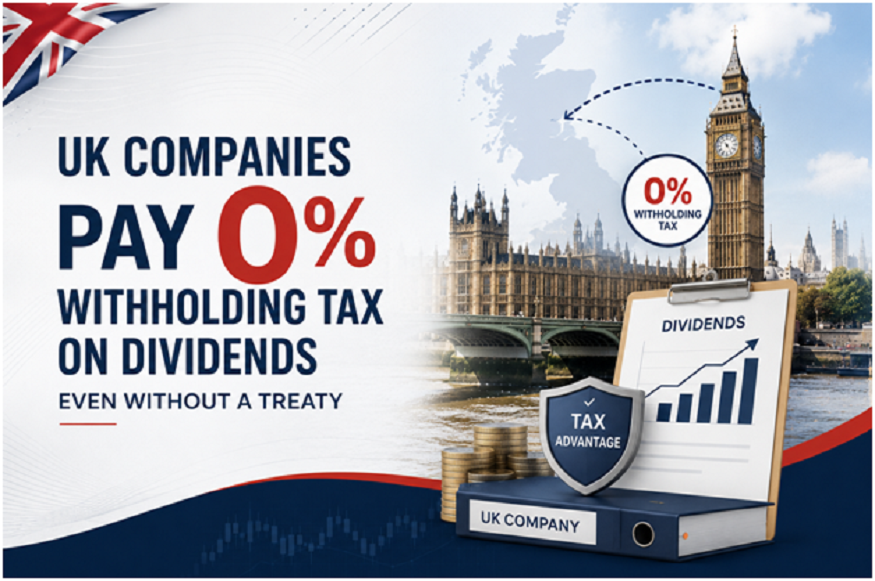
Nothing. HMRC takes zero on dividend distributions to shareholders, regardless of where those shareholders live, and regardless of whether the UK has a tax treaty with their home country.
This isn’t a loophole or a temporary policy position. It’s how UK dividend taxation is structured. The UK abolished advance corporation tax on dividends in 1999 and has never applied a withholding tax layer on ordinary dividend payments since. Most founders and finance people assume something must apply because virtually every other major economy has one and spend time hunting for treaty provisions that would reduce a rate that doesn’t exist in the first place.
Why this surprises people
The confusion is reasonable. If you’re used to operating from the US, Germany, India, Singapore, or most other jurisdictions, you’re accustomed to a withholding tax layer on outbound dividends, often 15–30% before any treaty reduction. The default assumption, when dealing with any country, is that withholding tax applies and you need to find the treaty article that reduces it.
With UK dividends, there’s no rate to reduce. The UK’s domestic legislation simply doesn’t impose withholding tax on dividend payments, and no treaty overrides this. A shareholder in Mumbai, Lagos, Austin, or Dubai receives the same gross dividend that a UK-resident shareholder receives. The tax question then shifts entirely to the shareholder’s home jurisdiction: what does India, Nigeria, the US, or the UAE do with that income on receipt? That’s a separate analysis, and one worth doing carefully, but it has nothing to do with HMRC.
What the UK does tax at source
Understanding what withholding doesn’t apply to is easier once you know what UK withholding tax does cover.
Interest payments from a UK Company to a non-resident creditor are subject to 20% withholding tax under UK domestic law, reducible by treaty. Royalties and certain intellectual property licence payments are also subject to 20% withholding, again treaty-reducible. If you’re structuring intercompany debt or IP licensing into a UK entity, treaty position matters a lot. If you’re simply taking profits as dividends, it doesn’t.
This distinction matters for how you structure a holding company or a payment flow. A founder who routes IP royalties through their UK company before distributing profits will face a different analysis than one who earns trading income and distributes it as a dividend. The corporate structure choice changes which withholding rules are in play.
How dividend taxation actually works for a UK Ltd
A UK limited company pays corporation tax on its profits currently 25% for companies with profits above £250,000, and 19% for companies with profits at or below £50,000, with marginal relief between those thresholds. After corporation tax, the remaining profits belong to shareholders and can be distributed.
When a distribution is declared, HMRC’s involvement ends. The company doesn’t file a withholding return. It doesn’t deduct anything. It doesn’t issue a certificate for foreign tax credit purposes (because there’s nothing to certify). The shareholder receives the full declared amount and handles their own reporting obligations in their home country.
For UK-resident individual shareholders, there’s a separate dividend tax regime at the personal level but that’s a personal income tax matter, not a withholding tax. Non-resident shareholders aren’t subject to that personal tax unless they have UK income tax obligations for other reasons.
The treaty search that doesn’t need to happen
Because advisors are trained to check treaty provisions before any cross-border dividend flows, many non-UK founders end up in an unnecessary research loop. They check the UK-India treaty (Article 10 sets a 15% ceiling on dividends but as the UK’s domestic rate is 0%, the treaty ceiling is irrelevant). They check the UK-US treaty (15% ceiling, same logic). They ask whether their country has a treaty with the UK at all.
None of this changes the outcome. The 0% domestic rate is more favourable than any treaty rate, so the treaty simply doesn’t apply to dividends. The analysis you actually need to do is on the receiving end: how your home country taxes foreign dividend income, whether a foreign tax credit is available, and whether the UK’s £0 withholding creates a foreign tax credit gap that costs you money in aggregate.
That last point is worth sitting with. In countries that tax foreign dividends at the corporate level and grant a credit for foreign withholding tax paid, receiving a gross dividend with no UK tax withheld can sometimes produce a higher net tax bill at home than receiving a dividend with 10–15% withheld (which generates a usable credit). This is particularly worth checking if you’re operating through a holding company structure in a country with a participation exemption the exemption may not apply to dividends from jurisdictions with very low or zero tax on the distributed income.
A real-world flow to make this concrete
Take a software company incorporated as a UK private limited company. The sole director and 100% shareholder lives in Bangalore. The company earns £180,000 in trading profit in a year.
Corporation tax at 26.5% (marginal rate on this amount, roughly) takes the liability to approximately £47,700. The company retains £132,300 after tax. The director declares a dividend of £132,300.
HMRC receives nothing at dividend payment. No form is filed. The £132,300 lands in the director’s Indian bank account in full. The Indian tax authority the Income Tax Department then asks what that foreign dividend income is and applies Indian tax rules to it. As of financial year 2023-24, foreign dividends are taxable in India at the applicable slab rate with no DTA reduction available on the India side because there was no tax withheld in the UK to credit. The net outcome depends on the Indian director’s total income picture, not on any UK withholding.
This is the analysis non-resident UK company owners actually need to do: work backward from their home country’s foreign income tax treatment, not forward from a UK withholding rate that doesn’t exist.
What this means for holding company planning
For founders using a UK Ltd as an operating company under a holding structure say, a UAE holding company owning 100% of a UK trading subsidiary the 0% withholding on dividends from the UK subsidiary to the UAE holdco is genuinely useful. There’s no UK cost to extracting profits upstream. Whether those profits are then taxable at the UAE level depends on UAE corporate tax rules (corporate tax at 9% applies to UAE entities with taxable income above AED 375,000, with certain exemptions for qualifying holding income).
The UK entity’s 0% dividend withholding is one layer of a multi-layer analysis. But it’s a clean, reliable layer no treaty required, no forms to file, no certificate to obtain.
The one thing to verify
The only scenario where withholding might appear in a UK dividend context is if the distributing company has undistributed investment income from UK real estate investment trust (REIT) distributions or certain property investment vehicle payments these have their own withholding regimes. Ordinary trading company dividends are outside these structures.
If your UK Ltd is a standard trading or services company, the analysis is simple: corporation tax on profits, then clean dividends out. The withholding conversation is about interest and royalties, not equity distributions.
Worth knowing before you spend three hours with the UK-[your country] treaty looking for an article that reduces a rate that was already zero.







Leave a Reply